Question

A small publishing company has a network design such that when a broadcast is sent on the LAN, 200 devices receive the transmitted broadcast. How can the network administrator reduce the number of devices that receive broadcast traffic?

Question

What is the reason for disabling SSID broadcasting and changing the default SSID on a wireless access point?

Question

What address and prefix length is used when configuring an IPv6 default static route?

Question

Match the purpose with its DHCP message type.

  1. DHCPREQUEST → A message that is used to locate any available DHCP server on a network
  2. DHCPDISCOVER → A message that is used to identify the explicit server and lease offer to accept
  3. DHCPNAK → A message that is used to acknowledge that the lease is successful
  4. DHCPOFFER → A message that is used to suggest a lease to a client
  5. DHCPACK → A message is used by a server to finalize a successful lease with a client

Question

The graphic shows two routers, R1 and ISP, that are connected together on two WAN links.  On the first WAN link, R1 connects to the ISP router through interface S0/0/0 and IP address 192.168.0.33/30, and the ISP router uses interface S0/0/0 and IP address 192.168.0.33/30. On the second WAN link R1 is connects to the ISP router through interface S0/0/1 and IP address 192.168.0.37/30,  and the ISP router uses interface S0/0/1 and IP address 192.168.0.38/30. OSPF is running as the routing protocol across the WAN link 192.168.0.32/30.

Refer to the exhibit. Router R1 has an OSPF neighbor relationship with the ISP router over the 192.168.0.32 network. The 192.168.0.36 network link should serve as a backup when the OSPF link goes down. The floating static route command ip route 0.0.0.0 0.0.0.0 S0/0/1 100 was issued on R1 and now traffic is using the backup link even when the OSPF link is up and functioning. Which change should be made to the static route command so that traffic will only use the OSPF link when it is up?

Question

A network administrator is implementing DHCPv6 for the company. The administrator configures a router to send RA messages with M flag as 1 by using the interface command ipv6 nd managed-config-flag. What effect will this configuration have on the operation of the clients?

Question

An administrator has configured a DHCPv4 relay router and issued these commands:

Router(config)# interface g0/0
Router(config-if)# ip address 10.0.1.1 255.255.255.0
Router(config-if)# no shutdown
Router(config-if)# exit
Router(config)# ip dhcp pool RELAY
Router(dhcp-config)# end

The clients are not receiving IP parameters from the DHCPv4 server. What is a possible cause?

Question

Match the DTP mode with its function.

  1. Dynamic auto → Passively waits for the neighbor to initiate trunking
  2. Nonegotiate → Requires manual configuration of trunking or nontrunking
  3. Dynamic desirable → Actively attempts to convert the link to a trunk
  4. Trunk → Permanent trunking mode

Question

Which type of traffic is designed for a native VLAN?

Question

Host PC-A is connected to Fa0/1 on switch ALS1. ALS1 is connected via Fa0/18 to switch ALS2. ALS2 is connected to host PC-B. The following CLI output accompanies the topology:  ALS1# show interfaces trunk Port        Mode             Encapsulation  Status        Native vlan Fa0/18      on               802.1q         trunking      99 Port        Vlans allowed on trunk Fa0/18      1,10,20,30,40,50,70,80,90,100,1001-1005 Port        Vlans allowed and active in management domain Fa0/18      1,10,20,30,40,50,70,80,90,100 Port        Vlans in spanning tree forwarding state and not pruned Fa0/18      1,10,20,30,40,50,70,80,90,100

Refer to the exhibit. PC-A and PC-B are both in VLAN 60. PC-A is unable to communicate with PC-B. What is the problem?

Question

CLI output that says the following:  DLS1# show interfaces trunk Port        Mode             Encapsulation  Status        Native vlan Fa0/1       on               802.1q         trunking      99 Port        Vlans allowed on trunk Fa0/1       1,10,20,30,99,1001-1005 Port        Vlans allowed and active in management domain Fa0/1       1,10,20,30,99 Port        Vlans in spanning tree forwarding state and not pruned Fa0/1       10,20,30,99 DLS1# *Mar  1 00:05:53.554: %CDP-4-NATIVE_VLAN_MISMATCH: Native VLAN mismatch discovered on FastEthernet0/1 (99), with DLS2 FastEthernet0/1 (66). DLS1#

Refer to the exhibit. DLS1 is connected to another switch, DLS2, via a trunk link. A host that is connected to DLS1 is not able to communicate to a host that is connected to DLS2, even though they are both in VLAN 99. Which command should be added to Fa0/1 on DLS1 to correct the problem?

Question

The exhibit shows 3 PCs connected to a switch through Fa0/2, Fa0/3, and Fa0/4 interfaces. The switch is connected to a router through the Fa0/1 interface. The exhibit also shows this partial output from the show running-config command: <output omitted> interface FastEthernet0/1  switchport trunk allowed vlan 10,20,30  switchport mode access  switchport nonegotiate ! interface FastEthernet0/2  switchport access vlan 10  switchport mode access  switchport nonegotiate ! interface FastEthernet0/3  switchport access vlan 20  switchport mode access  switchport nonegotiate ! interface FastEthernet0/4  switchport access vlan 30  switchport mode access  switchport nonegotiate

Refer to the exhibit. Inter-VLAN communication between VLAN 10, VLAN 20, and VLAN 30 is not successful. What is the problem?

Question

A network administrator is using the router-on-a-stick method to configure inter-VLAN routing. Switch port Gi1/1 is used to connect to the router. Which command should be entered to prepare this port for the task?

Question

Which problem is evident if the show ip interface command shows that the interface is down and the line protocol is down?

Question

PCA attaches to SW1 through port Fa0/1. PCB attaches to SW1 through port Fa0/2. The Fa0/23 port of SW1 attaches to the Fa0/24 port of SW2. PCc attaches to SW2 through port Fa0/3. PCD attaches to SW2 through port Fa0/4.

Refer to the exhibit. How is a frame sent from PCA forwarded to PCC if the MAC address table on switch SW1 is empty?

Question

R1# show running-config <output omitted> ipv6 unicast-routing ! ipv6 dhcp pool LAN1  prefix-delegation 2001:DB8:5::/48 00030001000E84244E70  dns-server 2001:DB8:5::8  domain-name cisco.com ! interface FastEthernet0/0  no ip address  ipv6 address 2001:DB8:5::100/48  ipv6 dhcp server LAN1

Refer to the exhibit. The users on the LAN network of R1 cannot receive an IPv6 address from the configured stateful DHCPv6 server. What is missing from the stateful DHCPv6 configuration on router R1?

Question

Which command would create a valid IPv6 default route?

Question

Which three components are combined to form a bridge ID? (Choose three.)

Question

What is an advantage of PVST+?

Question

Match the spanning-tree feature with the protocol type.

  1. PVST+ → Proprietary per VLAN implementation of IEEE 802.1w
  2. RSTP → Cisco implementation of IEEE 802.1D
  3. MSTP → Fast converging enhancement of IEEE 802.1D
  4. MST → IEEE standard that reduces the number of STP instances

Question

A network engineer is configuring a LAN with a redundant first hop to make better use of the available network resources. Which protocol should the engineer implement?

Question

Which combination of WLAN authentication and encryption is recommended as a best practice for home users?

Question

An employee connects wirelessly to the company network using a cell phone. The employee then configures the cell phone to act as a wireless access point that will allow new employees to connect to the company network. Which type of security threat best describes this situation?

Question

The exhibit displays the following information: S1# show __________ Port state    = Up Mstr Assoc In-Bndl Channel group = 1           Mode = Active         Gcchange = - Port-channel  = Po3         GC   =   -            Pseudo port-channel = Po3 Port index    = 0           Load = 0x00           Protocol =   LACP Flags: S - Device is sending Slow LACPDUs F - Device is sending fast LACPDUs.        A - Device is in active mode.      P - Device is in passive mode. Local information:                             LACP port     Admin     Oper    Port       Port Port      Flags   State     Priority      Key       Key     Number     State Fa0/11     SA      bndl      32768         0x1       0x1     0x101      0x3D  Partner's information:                   LACP port                       Admin  Oper   Port    Port Port      Flags   Priority  Dev ID          Age   key    Key    Number  State Fa0/11     SA      32768     0cd6.23d2.4000  11s   0x0    0x1    0x101   0x3D  <Output omitted>

Refer to the exhibit. A network administrator is troubleshooting a problem with EtherChannel. What command was used to produce the exhibited output?

Question

Which command will start the process to bundle two physical interfaces to create an EtherChannel group via LACP?

Question

What is a result of connecting two or more switches together?

Question

What is the best way to prevent a VLAN hopping attack?

Question

After sticky learning of MAC addresses is enabled, what action is needed to prevent dynamically learned MAC addresses from being lost in the event that an associated interface goes down?

Question

At the top of the graphic is a router labeled R1 that connects to a switch through R1 Gi0/0 and the switch Gi0/1 port. Below the switch are two hosts labeled H1 and H2 that connect using ports Fa0/1 and Fa0/2. Below H1 are the words VLAN 10. Below H2 are the words VLAN 20.   Beside the router are the following commands: R1(config)# interface gi0/0  R1(config-if)# no shutdown R1(config-if)# interface gi0/0.10 R1(config-subif)# encapsulation dot1q 10 R1(config-subif)# ip address 192.168.10.1 255.255.255.0 R1(config-if)# interface gi0/0.20 R1(config-subif)# encapsulation dot1q 20 R1(config-subif)# ip address 192.168.20.1 255.255.255.0    Beside the switch are the following commands: S1(config)# interface gi0/1  S1(config-if)# switchport mode trunk S1(config)# interface fa0/1  S1(config-if)# switchport mode access S1(config)# interface fa0/2  S1(config-if)# switchport mode access

Refer to the exhibit. The configuration shows commands entered by a network administrator for inter-VLAN routing. However, host H1 cannot communicate with H2. Which part of the inter-VLAN configuration causes the problem?

Question

In what situation would a Layer 2 switch have an IP address configured?

Question

Consider the following command:

ip route 192.168.10.0 255.255.255.0 10.10.10.2 5

What does the 5 at the end of the command signify?

Question

On which port should Dynamic ARP Inspection (DAI) be configured on a switch?

Question

The graphic contains the following configuration commands: S1(config)# interface fa0/1                       S1(config-if)# switchport port-security              Command rejected: FastEthernet0/1 is a dynamic port. S1(config-if)#​

Refer to the exhibit. The administrator wants to enable port security on an interface on switch S1, but the command was rejected. Which conclusion can be drawn?​

Question

What are the two methods that a wireless NIC can use to discover an AP? (Choose two.)

Question

Which term describes the role of a Cisco switch in the 802.1X port-based access control?

Question

Match the dynamic routing protocol component to the characteristic.

  1. Tables or databases that are stored in RAM → Data structures
  2. Exchanges routing information and maintains accurate information about networks → Routing protocol messages
  3. A finite list of steps used to determine the best path → Algorithm

Question

A small coffee shop is offering free Wi-Fi to customers. The network includes a wireless router and a DSL modem that is connected to the local phone company. What method is typically used to configure the connection to the phone company?

Question

The graphic shows the following text: R1# show ipv6 route  <output omitted>  S ::/0 [1/0] via Serial0/0/0, directly connected C 2001:DB8:CAFE:1::/64 [0/0] via GigabitEthernet0/1, directly connected L 2001:DB8:CAFE:1::1/128 [0/0] via GigabitEthernet0/1, receive C 2001:DB8:CAFE:2::/64 [0/0] via GigabitEthernet0/0, directly connected L 2001:DB8:CAFE:2::1/128 [0/0] via GigabitEthernet0/0, receive C 2001:DB8:CAFE:3::/64 [0/0] via Serial0/0/0, directly connected L 2001:DB8:CAFE:3::1/128 [0/0] via Serial0/0/0, receive S 2001:DB8:CAFE:4::1/128 [1/0] via Serial0/0/0, directly connected L FF00::/8 [0/0] via Null0, receive

Refer to the exhibit. How was the host route 2001:DB8:CAFE:4::1/128 installed in the routing table?

Question


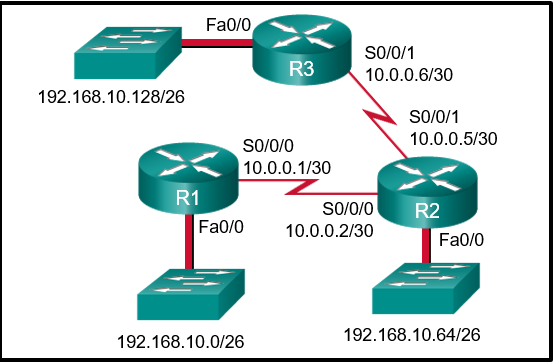
Gateway of last resort is not set

10.0.0.0/30 is subnetted, 2 subnets
C 10.0.0.0 is directly connected, Serial0/0/0
C 10.0.0.4 is directly connected, Serial0/0/1
192.168.10.0/26 is subnetted, 3 subnets
S 192.168.10.0 is directly connected, Serial0/0/0
C 192.168.10.64 is directly connected, FastEthernet0/0
S 192.168.10.128 [1/0] via 10.0.0.6

What will router R2 do with a packet destined for 192.168.10.129?

Question

Refer to the exhibit. Match the description with the routing table entries.

  1. Next hop → 172.16.2.2
  2. Destination network → 10.3.0.0
  3. Metric → 21024000
  4. Administrative distance → 1
  5. Route timestamp → 00:22:15
  6. Route source protocol → D

Question

The exhibit displays the following command and some partial output: S1# show etherchannel summary <output omitted> Number of channel-groups in use: 1Number of aggregators: 1 Group   Port-channel   Protocol    Ports 1       Po1(SU)          -        Fa0/10(P)  Fa0/11(p)

Refer to the exhibit. Based on the command output shown, what is the status of the EtherChannel?

Question

In this graphic there are two routers, two switches, and two PCs. Router R2 is connected on interface S0/0/1 to interface S0/0/0 on Router R1 via a serial link with the network 10.0.0.0/30. The letters PPP are above the serial link. Router R1 is connected on Gig0/0 to switch SW2 and switch SW2 is connected to PC2. PC2 has an IP address of 192.168.11.2/24. Router R1 is connected via Gig0/1 to switch SW1 and switch SW1 is connected to PC1. PC1 has an IP address of 192.168.10.2/24 Below the graphic is the following output: R1# show ip route <output omitted>  Gateway of last resort is 0.0.0.0 to network 0.0.0.0  10.0.0.0/8 is variably subnetted, 2 subnets, 2 masks C 10.0.0.0/30 is directly connected, Serial0/0/0 L 10.0.0.1/32 is directly connected, Serial0/0/0 192.168.10.0/24 is variably subnetted, 2 subnets, 2 masks C 192.168.10.0/24 is directly connected, GigabitEthernet0/1 L 192.168.10.1/32 is directly connected, GigabitEthernet0/1 192.168.11.0/24 is variably subnetted, 2 subnets, 2 masks C 192.168.11.0/24 is directly connected, GigabitEthernet0/0 L 192.168.11.1/32 is directly connected, GigabitEthernet0/0 S* 0.0.0.0/0 is directly connected, Serial0/0/0

Refer to the exhibit. When a packet arrives on interface Serial0/0/0 on R1, with a destination IP address of PC1, which two events occur? (Choose two)

Question

Which Cisco solution helps prevent ARP spoofing and ARP poisoning attacks?

Question

Which statement describes the behavior of a switch when the MAC address table is full?

Question

The graphic shows configuration commands:

SW1(config)# ip arp inspection validate ip
SW1(config)# ip arp inspection validate src-mac
SW1(config)# ip arp inspection validate dst-mac
SW1(config)# end
SW1(config)#

Refer to the exhibit. A network administrator is configuring DAI on switch SW1. What is the result of entering the exhibited commands?

Question

A network administrator of a college is configuring WLAN security with WPA2 Enterprise authentication. Which server is required when deploying this type of authentication?

Question

What is a potential issue when using the WLC to upgrade and deploy the latest firmware image to all APs?

Question

What are two switch characteristics that could help alleviate network congestion? (Choose two.)

Question

What are two characteristics of Cisco Express Forwarding (CEF)? (Choose two.)

Question

              172.18.109.0/26 is variously subnetted,  7 subnets,  3 masks
O                   172.18.109.0/26  [110/10]  via 172.18.32.1,  00:00:24, Serial0/0/0
O                   172.18.109.64/26  [110/20]  via  172.18.32.6,  00:00:56,  Serial 0/0/1
O                   172.18.109.128/26  [110/10]  via 172.18.32.1,  00:00:24,  Serial 0/0/0
C                   172.18.109.192/27 is directly connected,  GigabitEthernet0/0
L                    172.18.109.193/27 is directly connected,  GigabitEthernet0/0
C                   172.18.109.224/27 is directly connected,  GigabitEthernet0/1
L                    172.18.109.225/27 is directly connected, GigabitEthernet0/1
               172.18.32.0/24  is variably subnetted,  4 subnets,  2 masks
C                   172.18.32.0/30  is directly connected, Serial0/0/0
L                    172.18.32.2/32  is directly connected, Serial0/0/0
C                   172.18.32.4/30  is directly connected, Serial0/0/1
L                    172.18.32.5/32  is directly connected, Serial0/0/1
S              172.18.33.0/26   [1/0]   via  172.18.32.1,  00:00:24,   Serial0/0/0
R1#

Refer to the exhibit. Which interface will be the exit interface to forward a data packet that has the destination IP address 172.18.109.152?

Question

A junior technician was adding a route to a LAN router. A traceroute to a device on the new network revealed a wrong path and unreachable status. What should be done or checked?

Question

Match the FHRP protocols to the appropriate description.

  1. GLBP → A Cisco proprietary FHRP that provides load sharing in addition to redundancy
  2. HSRP → A Cisco proprietary FHRP that provides redundancy through use of an active device and standby device
  3. VRRP → An open standard FHRP that provides redundancy through use of a virtual routers master and one or more backups

Question

A technician is configuring a new Cisco 2960 switch. What is the effect of issuing the BranchSw(config)#interface VLAN88 command?

Question

A network administrator is configuring a WLC to provide WLAN access to users in an office building. When testing the newly created WLAN, the administrator does not see the SSID from a wireless device. What is a possible cause?

Question

What type of VLAN is configured specifically for network traffic such as SSH, Telnet, HTTPS, HTTP, and SNMP?