Question
![The exhibit shows the following router output: The gateway of last resort is 209.165.200.226 to network 0.0.0.0 S* 0.0.0.0/0 [1/0] via 209.165.200.226 192.168.10.0/24 is variably subnetted, 2 subnets, 2 masks C 192.168.10.0/24 is directly connected, GigabitEthernet0/0 L 192.168.10.1/32 is directly connected, GigabitEthernet0/0 192.168.11.0/24 is variably subnetted, 2 subnets, 2 masks C 192.168.11.0/24 is directly connected, GigabitEthernet0/1 L 192.168.11.1/32 is directly connected, GigabitEthernet0/1 209.165.200.0/24 is variably subnetted, 2 subnets, 2 masks C 209.165.200.224/30 is directly connected, Serial0/0/0 L 209.165.200.225/32 is directly connected, Serial0/0/0](assets/i209407v1n1_209408.jpg)
Refer to the exhibit. What will the router do with a packet that has a destination IP address of 192.168.12.227?
Refer to the exhibit. What will the router do with a packet that has a destination IP address of 192.168.12.227?
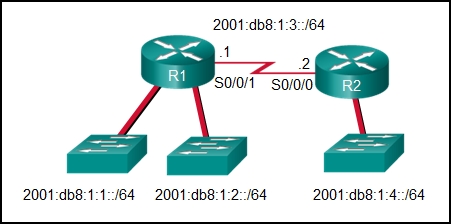
Refer to the exhibit. What command would be used to configure a static route on R1 so that traffic from both LANs can reach the 2001:db8:1:4::/64 remote network?
A network administrator configures the interface fa0/0 on the router R1 with the command ip address 172.16.1.254 255.255.255.0. However, when the administrator issues the command show ip route, the routing table does not show the directly connected network. What is the possible cause of the problem?
What are two advantages of static routing over dynamic routing? (Choose two.)
A router has used the OSPF protocol to learn a route to the 172.16.32.0/19 network. Which command will implement a backup floating static route to this network?
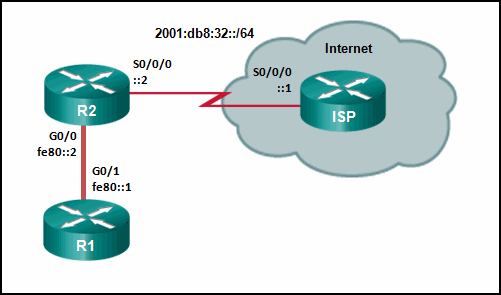
Refer to the exhibit. Which default static route command would allow R1 to potentially reach all unknown networks on the Internet?
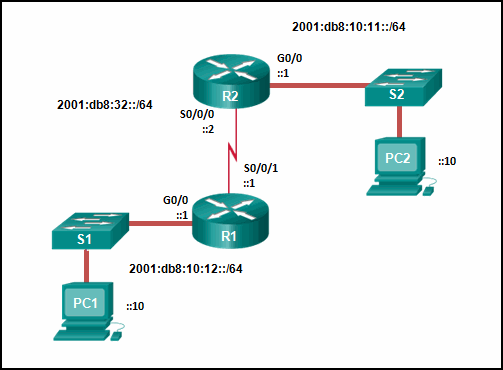
Refer to the exhibit. Which command will properly configure an IPv6 static route on R2 that will allow traffic from PC2 to reach PC1 without any recursive lookups by router R2?
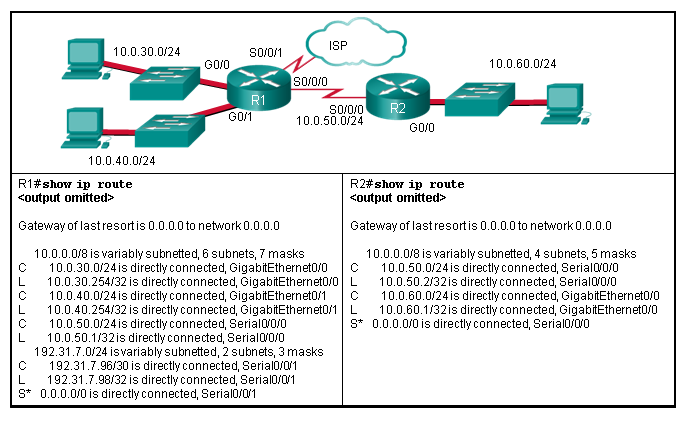
Refer to the exhibit. The small company shown uses static routing. Users on the R2 LAN have reported a problem with connectivity. What is the issue?
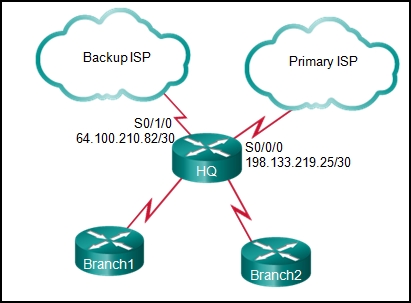
Refer to the exhibit. The network engineer for the company that is shown wants to use the primary ISP connection for all external connectivity. The backup ISP connection is used only if the primary ISP connection fails. Which set of commands would accomplish this goal?
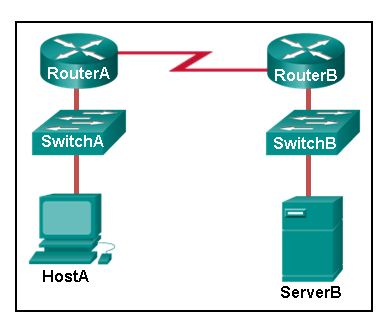
Refer to the exhibit. HostA is attempting to contact ServerB. Which two statements correctly describe the addressing that HostA will generate in the process? (Choose two.)
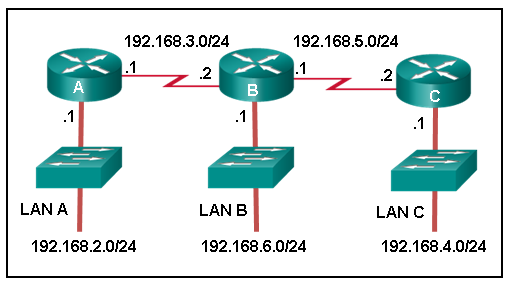
Refer to the graphic. Which command would be used on router A to configure a static route to direct traffic from LAN A that is destined for LAN C?
On which two routers would a default static route be configured? (Choose two.)
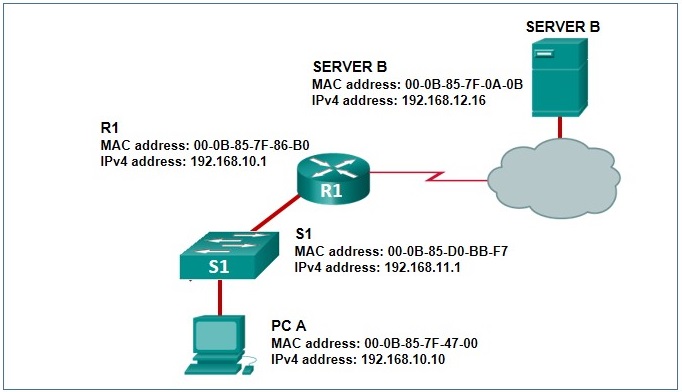
Refer to the exhibit. PC A sends a request to Server B. What IPv4 address is used in the destination field in the packet as the packet leaves PC A?
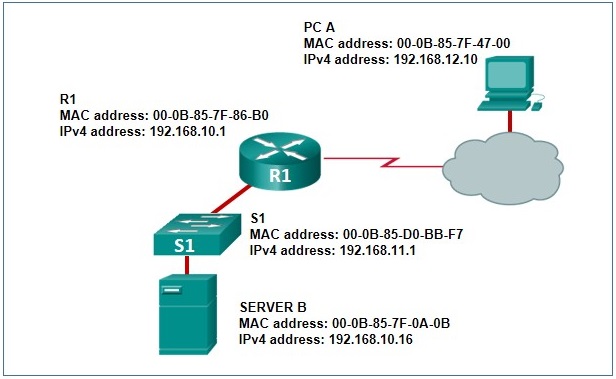
Refer to the exhibit.
What does R1 use as the MAC address of the destination when constructing the frame that will go from R1 to Server B?
![The graphic displays a router R1 with a FastEthernet 0/0 interface labeled with the 192.168.3.0/24 address. R1 also has a FastEthernet 0/1 interface labeled with the 192.168.4.0/24 address. R1 is connected to a router R2 using the Serial 0/0/0 interface labeled with the IP address 10.1.1.1/30. R2 is connected to R1 using the Serial 0/0/0 interface which is labeled with the address 10.1.1.2/30. R2 also has a FastEthernet 0/0 interface labeled with the 192.168.2.0/24 address and a FastEthernet 0/1 interface labeled with the 192.168.1.0/24 address. Below there is a text as follows: R1# show ip route <output ommited> Gateway of last resort is not set 10.0.0.0/30 is subnetted, 1 subnets C 10.1.1.0 is directly connected, Serial0/0/0 D 192.168.1.0 [120/1] via 10.1.1.2 00:03:50, Serial0/0/0 C 192.168.3.0/24 is directly connected, FastEthernet0/0 C 192.168.4.0/24 is directly connected, FastEthernet0/1 S 192.168.2.0/24 [1/0] via 192.168.3.0](assets/i222884v1n1_222884.jpg)
Refer to the exhibit. A ping from R1 to 10.1.1.2 is successful, but a ping from R1 to any address in the 192.168.2.0 network fails. What is the cause of this problem?
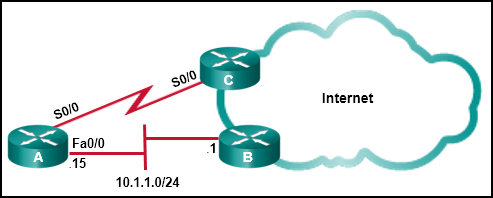
Refer to the exhibit. This network has two connections to the ISP, one via router C and one via router B. The serial link between router A and router C supports EIGRP and is the primary link to the Internet. If the primary link fails, the administrator needs a floating static route that avoids recursive route lookups and any potential next-hop issues caused by the multiaccess nature of the Ethernet segment with router B. What should the administrator configure?
What two pieces of information are needed in a fully specified static route to eliminate recursive lookups? (Choose two.)
What happens to a static route entry in a routing table when the outgoing interface associated with that route goes into the down state?
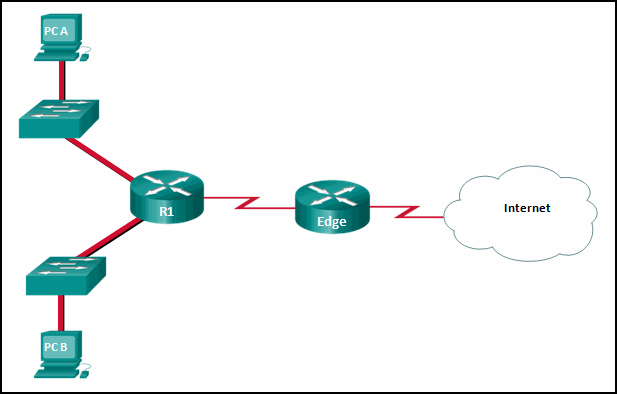
Refer to the exhibit. What routing solution will allow both PC A and PC B to access the Internet with the minimum amount of router CPU and network bandwidth utilization?
What is a characteristic of a floating static route?
Which value in a routing table represents trustworthiness and is used by the router to determine which route to install into the routing table when there are multiple routes toward the same destination?
What is a characteristic of a static route that matches all packets?
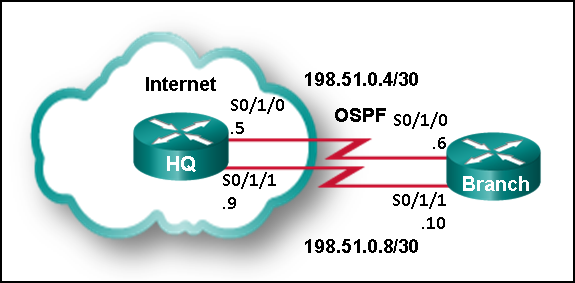
Refer to the exhibit. The Branch Router has an OSPF neighbor relationship with the HQ router over the 198.51.0.4/30 network. The 198.51.0.8/30 network link should serve as a backup when the OSPF link goes down. The floating static route command ip route 0.0.0.0 0.0.0.0 S0/1/1 100 was issued on Branch and now traffic is using the backup link even when the OSPF link is up and functioning. Which change should be made to the static route command so that traffic will only use the OSPF link when it is up?
What network prefix and prefix-length combination is used to create a default static route that will match any IPv6 destination?
What route would have the lowest administrative distance?
Consider the following command:
ip route 192.168.10.0 255.255.255.0 10.10.10.2 5
Which route would have to go down in order for this static route to appear in the routing table?
Consider the following command:
ip route 192.168.10.0 255.255.255.0 10.10.10.2 5
What does the 5 at the end of the command signify?
Consider the following command:
ip route 192.168.10.0 255.255.255.0 10.10.10.2 5
How would an administrator test this configuration?
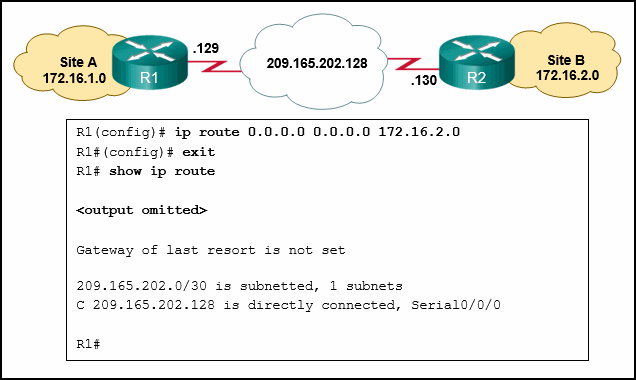
Refer to the exhibit. An administrator is attempting to install a default static route on router R1 to reach the Site B network on router R2. After entering the static route command, the route is still not showing up in the routing table of router R1. What is preventing the route from installing in the routing table?
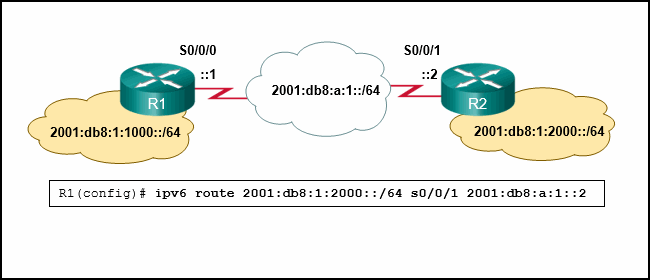
Refer to the exhibit. An administrator is attempting to install an IPv6 static route on router R1 to reach the network attached to router R2. After the static route command is entered, connectivity to the network is still failing. What error has been made in the static route configuration?
When would it be more beneficial to use a dynamic routing protocol instead of static routing?
Which route would be used to forward a packet with a source IP address of 192.168.10.1 and a destination IP address of 10.1.1.1?
![The graphic displays the following: R1# show ipv6 route IPv6 Routing Table - 8 entries <output omitted> S ::/0 [1/0] via 2001:DB8:F00D::A C 2001:DB8:CAFE:1::/64 [0/0] via GigabitEthernet0/1, directly connected L 2001:DB8:CAFE:1::1/128 [0/0] via GigabitEthernet0/1, receive S 2001:DB8:CAFE:2::/64 [1/0] via 2001:DB8:F00D:3::3 O 2001:DB8:CAFE:3::/64 [110/65]via GigabitEthernet0/0, directly connected R 2001:DB8:CAFE:4::/64 [120/4]via GigabitEthernet0/1, directly connected C 2001:DB8:F00D::/48 [0/0] via GigabitEthernet0/0, directly connected L 2001:DB8:F00D::1/128 [0/0] via GigabitEthernet0/0, receive L FF00::/8 [0/0] via Null0, receive](assets/i281319v1n3_281319.png)
Refer to the exhibit. What is the administrative distance value of the route for router R1 to reach the destination IPv6 address of 2001:DB8:CAFE:4::A?
![The graphic displays the following text: R1(config)# do show ip route <output omitted> Gateway of last resort is 0.0.0.0 to network 0.0.0.0 10.0.0.0/8 is variably subnetted, 2 subnets, 2 masks C 10.0.0.0/30 is directly connected, Serial0/0/0 L 10.0.0.1/32 is directly connected, Serial0/0/0 172.16.0.0/24 is subnetted, 1 subnets R 172.16.1.0/24 [120/1] via 10.0.0.2, 00:00:04, Serial0/0/0 192.168.10.0/24 is variably subnetted, 2 subnets, 2 masks C 192.168.10.0/24 is directly connected, GigabitEthernet0/1 L 192.168.10.1/32 is directly connected, GigabitEthernet0/1 192.168.11.0/24 is variably subnetted, 2 subnets, 2 masks C 192.168.11.0/24 is directly connected, GigabitEthernet0/0 L 192.168.11.1/32 is directly connected, GigabitEthernet0/0 S* 0.0.0.0/0 is directly connected, Serial0/0/0 R1(config)# ip route 172.16.1.0 255.255.255.0 s0/0/0](assets/i282901v1n1_Routing2.png)
Refer to the exhibit. What would happen after the IT administrator enters the new static route?
![The exhibit shows partial output of this router command: R1(config)# do show ip route <output omitted> Gateway of last resort is 0.0.0.0 to network 0.0.0.0 10.0.0.0/8 is variably subnetted, 2 subnets, 2 masks C 10.0.0.0/30 is directly connected, Serial0/0/0 L 10.0.0.1/32 is directly connected, Serial0/0/0 172.16.0.0/24 is subnetted, 1 subnets R 172.16.1.0/24 [120/1] via 10.0.0.2, 00:00:04, Serial0/0/0 192.168.10.0/24 is variably subnetted, 2 subnets, 2 masks C 192.168.10.0/24 is directly connected, GigabitEthernet0/1 L 192.168.10.1/32 is directly connected, GigabitEthernet0/1 192.168.11.0/24 is variably subnetted, 2 subnets, 2 masks C 192.168.11.0/24 is directly connected, GigabitEthernet0/0 L 192.168.11.1/32 is directly connected, GigabitEthernet0/0 S* 0.0.0.0/0 is directly connected, Serial0/0/0](assets/i282902v1n1_Routing3.png)
Refer to the exhibit. Which static route would an IT technician enter to create a backup route to the 172.16.1.0 network that is only used if the primary RIP learned route fails?
![The graphic shows the following text: R1# show ipv6 route <output omitted> S ::/0 [1/0] via Serial0/0/0, directly connected C 2001:DB8:CAFE:1::/64 [0/0] via GigabitEthernet0/1, directly connected L 2001:DB8:CAFE:1::1/128 [0/0] via GigabitEthernet0/1, receive C 2001:DB8:CAFE:2::/64 [0/0] via GigabitEthernet0/0, directly connected L 2001:DB8:CAFE:2::1/128 [0/0] via GigabitEthernet0/0, receive C 2001:DB8:CAFE:3::/64 [0/0] via Serial0/0/0, directly connected L 2001:DB8:CAFE:3::1/128 [0/0] via Serial0/0/0, receive S 2001:DB8:CAFE:4::1/128 [1/0] via Serial0/0/0, directly connected L FF00::/8 [0/0] via Null0, receive](assets/i282903v1n1_Routing5.png)
Refer to the exhibit. How was the host route 2001:DB8:CAFE:4::1/128 installed in the routing table?
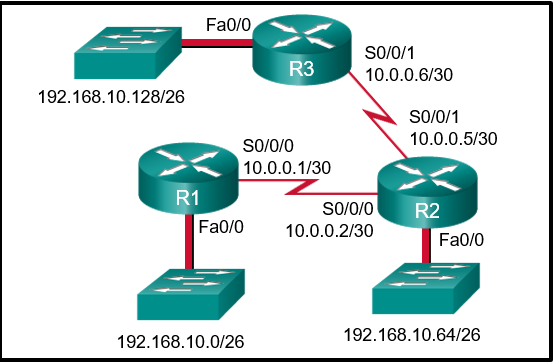
Refer to the exhibit. The routing table for R2 is as follows:
Gateway of last resort is not set
10.0.0.0/30 is subnetted, 2 subnets
C 10.0.0.0 is directly connected, Serial0/0/0
C 10.0.0.4 is directly connected, Serial0/0/1
192.168.10.0/26 is subnetted, 3 subnets
S 192.168.10.0 is directly connected, Serial0/0/0
C 192.168.10.64 is directly connected, FastEthernet0/0
S 192.168.10.128 [1/0] via 10.0.0.6
What will router R2 do with a packet destined for 192.168.10.129?
An administrator issues the ipv6 route 2001:db8:acad:1::/32 gigabitethernet0/0 2001:db8:acad:6::1 100 command on a router. What administrative distance is assigned to this route?
![Graphic shows output of show ip route as follows: A# show ip route <output ommited> Gateway of last resort is not set S 10.0.0.0/8 [1/0] via 172.16.40.2 64.0.0.0/16 is subnetted, 1 subnets C 64.100.0.0 is directly connected, Serial0/1/0 C 128.107.0.0/16 is directly connected, Loopback2 172.16.0.0/24 is subnetted, 1 subnets C 172.16.40.0 is directly connected, Serial0/0/0 C 192.168.1.0/24 is directly connected,FastEthernet0/0/0 S 192.168.2.0/24 [1/0] via 172.16.40.2 C 198.132.219.0/24 is directly connected, Loopback0](assets/i283590v1n1_14284.jpg)
Refer to the exhibit. What two commands will change the next-hop address for the 10.0.0.0/8 network from 172.16.40.2 to 192.168.1.2? (Choose two.)

Refer to the exhibit. Which type of IPv6 static route is configured in the exhibit?
Open the PT Activity. Perform the tasks in the activity instructions and then answer the question.
A user reports that PC0 cannot visit the web server www.server.com. Troubleshoot the network configuration to identify the problem.
What is the cause of the problem?
What characteristic completes the following statement?
When an IPv6 static route is configured, as a backup route to a static route in the routing table, the "distance" command is used with ......
What characteristic completes the following statement?
When an IPv6 static route is configured, as a backup route to a static route in the routing table, the "distance" command is used with ......
What characteristic completes the following statement?
When an IPv6 static route is configured, the installation of the route can be verified with ......
What characteristic completes the following statement?
When an IPv6 static route is configured, it is first necessary to configure ......
What characteristic completes the following statement?
When an IPv6 static route is configured, it is first necessary to configure ......
What characteristic completes the following statement?
When an IPv6 static route is configured, the next-hop address can be ......
What characteristic completes the following statement?
When an IPv6 static route is configured, the next-hop address can be ......
What characteristic completes the following statement?
When an IPv6 static route is configured, a fully-specified configuration should be used with ......
What characteristic completes the following statement?
When an IPv6 static route is configured, the installation of the route can be verified with ......
What characteristic completes the following statement?
When an IPv6 static route is configured, it is possible that the same IPv6 link-local address is used for ......
Gateway of last resort is not set.
172.19.115.0/26 is variously subnetted, 7 subnets, 3 masks
O 172.19.115.0/26 [110/10] via 172.19.39.1, 00:00:24, Serial0/0/0
O 172.19.115.64/26 [110/20] via 172.19.39.6, 00:00:56, Serial 0/0/1
O 172.19.115.128/26 [110/10] via 172.19.39.1, 00:00:24, Serial 0/0/0
C 172.19.115.192/27 is directly connected, GigabitEthernet0/0
L 172.19.115.193/27 is directly connected, GigabitEthernet0/0
C 172.19.115.224/27 is directly connected, GigabitEthernet0/1
L 172.19.115.225/27 is directly connected, GigabitEthernet0/1
172.19.39.0/24 is variably subnetted, 4 subnets, 2 masks
C 172.19.39.0/30 is directly connected, Serial0/0/0
L 172.19.39.2/32 is directly connected, Serial0/0/0
C 172.19.39.4/30 is directly connected, Serial0/0/1
L 172.19.39.5/32 is directly connected, Serial0/0/1
S 172.19.40.0/26 [1/0] via 172.19.39.1, 00:00:24, Serial0/0/0
R1#
Refer to the exhibit. Which interface will be the exit interface to forward a data packet that has the destination IP address 172.19.115.206?
Gateway of last resort is not set.
172.19.115.0/26 is variously subnetted, 7 subnets, 3 masks
O 172.19.115.0/26 [110/10] via 172.19.39.1, 00:00:24, Serial0/0/0
O 172.19.115.64/26 [110/20] via 172.19.39.6, 00:00:56, Serial 0/0/1
O 172.19.115.128/26 [110/10] via 172.19.39.1, 00:00:24, Serial 0/0/0
C 172.19.115.192/27 is directly connected, GigabitEthernet0/0
L 172.19.115.193/27 is directly connected, GigabitEthernet0/0
C 172.19.115.224/27 is directly connected, GigabitEthernet0/1
L 172.19.115.225/27 is directly connected, GigabitEthernet0/1
172.19.39.0/24 is variably subnetted, 4 subnets, 2 masks
C 172.19.39.0/30 is directly connected, Serial0/0/0
L 172.19.39.2/32 is directly connected, Serial0/0/0
C 172.19.39.4/30 is directly connected, Serial0/0/1
L 172.19.39.5/32 is directly connected, Serial0/0/1
S 172.19.40.0/26 [1/0] via 172.19.39.1, 00:00:24, Serial0/0/0
R1#
Refer to the exhibit. Which interface will be the exit interface to forward a data packet that has the destination IP address 172.19.115.206?
Gateway of last resort is not set.
192.168.139.0/26 is variously subnetted, 7 subnets, 3 masks
O 192.168.139.0/26 [110/10] via 192.168.70.1, 00:00:24, Serial0/0/0
O 192.168.139.64/26 [110/20] via 192.168.70.6, 00:00:56, Serial 0/0/1
O 192.168.139.128/26 [110/10] via 192.168.70.1, 00:00:24, Serial 0/0/0
C 192.168.139.192/27 is directly connected, GigabitEthernet0/0
L 192.168.139.193/27 is directly connected, GigabitEthernet0/0
C 192.168.139.224/27 is directly connected, GigabitEthernet0/1
L 192.168.139.225/27 is directly connected, GigabitEthernet0/1
192.168.70.0/24 is variably subnetted, 4 subnets, 2 masks
C 192.168.70.0/30 is directly connected, Serial0/0/0
L 192.168.70.2/32 is directly connected, Serial0/0/0
C 192.168.70.4/30 is directly connected, Serial0/0/1
L 192.168.70.5/32 is directly connected, Serial0/0/1
S 192.168.71.0/26 [1/0] via 192.168.70.1, 00:00:24, Serial0/0/0
R1#
Refer to the exhibit. Which interface will be the exit interface to forward a data packet that has the destination IP address 192.168.71.52?
Gateway of last resort is not set.
192.168.139.0/26 is variously subnetted, 7 subnets, 3 masks
O 192.168.139.0/26 [110/10] via 192.168.70.1, 00:00:24, Serial0/0/0
O 192.168.139.64/26 [110/20] via 192.168.70.6, 00:00:56, Serial 0/0/1
O 192.168.139.128/26 [110/10] via 192.168.70.1, 00:00:24, Serial 0/0/0
C 192.168.139.192/27 is directly connected, GigabitEthernet0/0
L 192.168.139.193/27 is directly connected, GigabitEthernet0/0
C 192.168.139.224/27 is directly connected, GigabitEthernet0/1
L 192.168.139.225/27 is directly connected, GigabitEthernet0/1
192.168.70.0/24 is variably subnetted, 4 subnets, 2 masks
C 192.168.70.0/30 is directly connected, Serial0/0/0
L 192.168.70.2/32 is directly connected, Serial0/0/0
C 192.168.70.4/30 is directly connected, Serial0/0/1
L 192.168.70.5/32 is directly connected, Serial0/0/1
S 192.168.71.0/26 [1/0] via 192.168.70.1, 00:00:24, Serial0/0/0
R1#
Refer to the exhibit. Which interface will be the exit interface to forward a data packet that has the destination IP address 192.168.139.244?
Gateway of last resort is not set.
172.25.128.0/26 is variously subnetted, 7 subnets, 3 masks
O 172.25.128.0/26 [110/10] via 172.25.56.1, 00:00:24, Serial0/0/0
O 172.25.128.64/26 [110/20] via 172.25.56.6, 00:00:56, Serial 0/0/1
O 172.25.128.128/26 [110/10] via 172.25.56.1, 00:00:24, Serial 0/0/0
C 172.25.128.192/27 is directly connected, GigabitEthernet0/0
L 172.25.128.193/27 is directly connected, GigabitEthernet0/0
C 172.25.128.224/27 is directly connected, GigabitEthernet0/1
L 172.25.128.225/27 is directly connected, GigabitEthernet0/1
172.25.56.0/24 is variably subnetted, 4 subnets, 2 masks
C 172.25.56.0/30 is directly connected, Serial0/0/0
L 172.25.56.2/32 is directly connected, Serial0/0/0
C 172.25.56.4/30 is directly connected, Serial0/0/1
L 172.25.56.5/32 is directly connected, Serial0/0/1
S 172.25.57.0/26 [1/0] via 172.25.56.1, 00:00:24, Serial0/0/0
R1#
Refer to the exhibit. Which interface will be the exit interface to forward a data packet that has the destination IP address 172.25.128.244?
Gateway of last resort is not set.
10.3.86.0/26 is variously subnetted, 7 subnets, 3 masks
O 10.3.86.0/26 [110/10] via 10.3.2.1, 00:00:24, Serial0/0/0
O 10.3.86.64/26 [110/20] via 10.3.2.6, 00:00:56, Serial 0/0/1
O 10.3.86.128/26 [110/10] via 10.3.2.1, 00:00:24, Serial 0/0/0
C 10.3.86.192/27 is directly connected, GigabitEthernet0/0
L 10.3.86.193/27 is directly connected, GigabitEthernet0/0
C 10.3.86.224/27 is directly connected, GigabitEthernet0/1
L 10.3.86.225/27 is directly connected, GigabitEthernet0/1
10.3.2.0/24 is variably subnetted, 4 subnets, 2 masks
C 10.3.2.0/30 is directly connected, Serial0/0/0
L 10.3.2.2/32 is directly connected, Serial0/0/0
C 10.3.2.4/30 is directly connected, Serial0/0/1
L 10.3.2.5/32 is directly connected, Serial0/0/1
S 10.3.3.0/26 [1/0] via 10.3.2.1, 00:00:24, Serial0/0/0
R1#
Refer to the exhibit. Which interface will be the exit interface to forward a data packet that has the destination IP address 10.3.86.2?
Gateway of last resort is not set.
172.18.109.0/26 is variously subnetted, 7 subnets, 3 masks
O 172.18.109.0/26 [110/10] via 172.18.32.1, 00:00:24, Serial0/0/0
O 172.18.109.64/26 [110/20] via 172.18.32.6, 00:00:56, Serial 0/0/1
O 172.18.109.128/26 [110/10] via 172.18.32.1, 00:00:24, Serial 0/0/0
C 172.18.109.192/27 is directly connected, GigabitEthernet0/0
L 172.18.109.193/27 is directly connected, GigabitEthernet0/0
C 172.18.109.224/27 is directly connected, GigabitEthernet0/1
L 172.18.109.225/27 is directly connected, GigabitEthernet0/1
172.18.32.0/24 is variably subnetted, 4 subnets, 2 masks
C 172.18.32.0/30 is directly connected, Serial0/0/0
L 172.18.32.2/32 is directly connected, Serial0/0/0
C 172.18.32.4/30 is directly connected, Serial0/0/1
L 172.18.32.5/32 is directly connected, Serial0/0/1
S 172.18.33.0/26 [1/0] via 172.18.32.1, 00:00:24, Serial0/0/0
R1#
Refer to the exhibit. Which interface will be the exit interface to forward a data packet that has the destination IP address 172.18.109.152?
Gateway of last resort is not set.
172.18.109.0/26 is variously subnetted, 7 subnets, 3 masks
O 172.18.109.0/26 [110/10] via 172.18.32.1, 00:00:24, Serial0/0/0
O 172.18.109.64/26 [110/20] via 172.18.32.6, 00:00:56, Serial 0/0/1
O 172.18.109.128/26 [110/10] via 172.18.32.1, 00:00:24, Serial 0/0/0
C 172.18.109.192/27 is directly connected, GigabitEthernet0/0
L 172.18.109.193/27 is directly connected, GigabitEthernet0/0
C 172.18.109.224/27 is directly connected, GigabitEthernet0/1
L 172.18.109.225/27 is directly connected, GigabitEthernet0/1
172.18.32.0/24 is variably subnetted, 4 subnets, 2 masks
C 172.18.32.0/30 is directly connected, Serial0/0/0
L 172.18.32.2/32 is directly connected, Serial0/0/0
C 172.18.32.4/30 is directly connected, Serial0/0/1
L 172.18.32.5/32 is directly connected, Serial0/0/1
S 172.18.33.0/26 [1/0] via 172.18.32.1, 00:00:24, Serial0/0/0
R1#
Refer to the exhibit. Which interface will be the exit interface to forward a data packet that has the destination IP address 172.18.109.152?
Gateway of last resort is not set.
10.55.99.0/26 is variously subnetted, 7 subnets, 3 masks
O 10.55.99.0/26 [110/10] via 10.55.18.1, 00:00:24, Serial0/0/0
O 10.55.99.64/26 [110/20] via 10.55.18.6, 00:00:56, Serial 0/0/1
O 10.55.99.128/26 [110/10] via 10.55.18.1, 00:00:24, Serial 0/0/0
C 10.55.99.192/27 is directly connected, GigabitEthernet0/0
L 10.55.99.193/27 is directly connected, GigabitEthernet0/0
C 10.55.99.224/27 is directly connected, GigabitEthernet0/1
L 10.55.99.225/27 is directly connected, GigabitEthernet0/1
10.55.18.0/24 is variably subnetted, 4 subnets, 2 masks
C 10.55.18.0/30 is directly connected, Serial0/0/0
L 10.55.18.2/32 is directly connected, Serial0/0/0
C 10.55.18.4/30 is directly connected, Serial0/0/1
L 10.55.18.5/32 is directly connected, Serial0/0/1
S 10.55.19.0/26 [1/0] via 10.55.18.1, 00:00:24, Serial0/0/0
R1#
Refer to the exhibit. Which interface will be the exit interface to forward a data packet that has the destination IP address 10.55.99.78?
Gateway of last resort is not set.
10.55.99.0/26 is variously subnetted, 7 subnets, 3 masks
O 10.55.99.0/26 [110/10] via 10.55.18.1, 00:00:24, Serial0/0/0
O 10.55.99.64/26 [110/20] via 10.55.18.6, 00:00:56, Serial 0/0/1
O 10.55.99.128/26 [110/10] via 10.55.18.1, 00:00:24, Serial 0/0/0
C 10.55.99.192/27 is directly connected, GigabitEthernet0/0
L 10.55.99.193/27 is directly connected, GigabitEthernet0/0
C 10.55.99.224/27 is directly connected, GigabitEthernet0/1
L 10.55.99.225/27 is directly connected, GigabitEthernet0/1
10.55.18.0/24 is variably subnetted, 4 subnets, 2 masks
C 10.55.18.0/30 is directly connected, Serial0/0/0
L 10.55.18.2/32 is directly connected, Serial0/0/0
C 10.55.18.4/30 is directly connected, Serial0/0/1
L 10.55.18.5/32 is directly connected, Serial0/0/1
S 10.55.19.0/26 [1/0] via 10.55.18.1, 00:00:24, Serial0/0/0
R1#
Refer to the exhibit. Which interface will be the exit interface to forward a data packet that has the destination IP address 10.55.99.78?
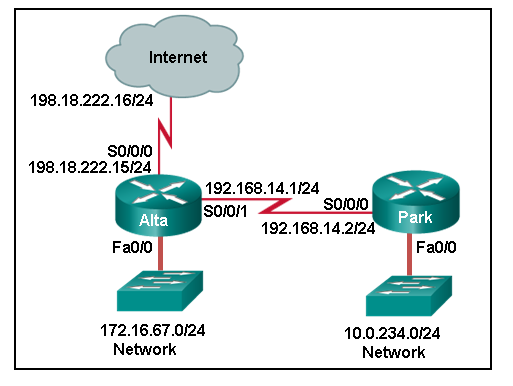
Refer to the exhibit. Which set of commands will configure static routes that will allow the Park and the Alta routers to a) forward packets to each LAN and b) direct all other traffic to the Internet?
Match the routing table entry to the corresponding function.
Match the routing table entry to the corresponding function.